
AI Cannot Be Ignored!
The 2020s have witnessed rapid growth in artificial intelligence (AI) adoption by businesses across various industries. These intelligent machines can learn over time and perform tasks ranging from automating repetitive tasks to enhancing customer experience and optimizing operations, shaping how businesses operate today. With this amount of recognition, we have passed the test stages of AI adoption and grown to the era where AI implementation is reaching unprecedented levels, with 79% of CEOs believing that AI investments can enhance business efficiencies.

According to studies, the enterprise adoption and implementation of AI and AI agents into business operations is expected to surpass 70% in 2025. Despite the competitive edge that comes with adopting AI into business processes, some enterprises are yet to understand the role AI can play in their business process.
The Role of AI in Today’s Business
AI is flexible, and this flexibility provides an advantage of being adopted across businesses of different industries. Its adaptability is a function of its ability to process large datasets, learn from patterns, and automate decision-making. Unlike how it was envisioned, AI and humans are working pari passu in today’s business landscape to create value, shifting the argument from whether AI will take over human jobs to how humans and AI can collaborate to deliver value. The various ways AI has been applied to improve business processes, enhance decision-making, and automate tasks can be seen below:
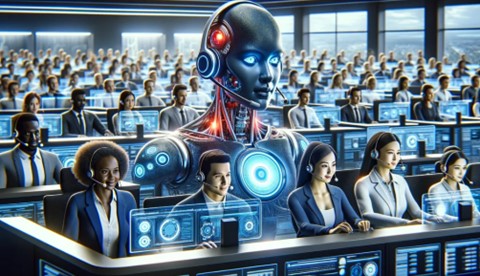
Customer Service: A notable application of AI in business is customer service, where AI-powered assistants are deployed to enhance user experience. AI agents have been employed to eliminate delays in customer conflict resolution. Businesses now use AI-powered chatbots and virtual assistants like Amazon’s Alexa. Google Assistant, Meta AI, etc., to provide instant responses, streamline support, and reduce waiting times. These AI agents have the capabilities to handle regular human functions like tracking orders, answering questions, schedule tasks, thereby, making customer support smarter and more efficient.
Marketing & Sales: It is safe to say that AI understands marketing core activities. AI strives to identify patterns and generate actional insights, this highlights its ability to effectively work on customers’ needs. Businesses harness this potential to drive strategic actions in personalized advertisement and content recommendations. It is no brainer how Netflix always knows what you are likely to binge next, why the ads on social media are all relevant suddenly, or why Amazon keeps recommending products you seem interested in. AI-driven marketing tools analyze customer behavior, browsing history, and purchase patterns to serve personalized recommendations.
Operations & Supply Chain: The supply chain industry is an industry where any delay or inefficiency can lead to significant losses. The capabilities of AI are currently being applied to optimize supply chain management. They predict demand, optimize inventories, and improve delivery efficiency. Companies like FedEx employ AI-driven route optimization to determine the fastest and most cost-effective delivery paths, reducing operational costs and eliminating delivery delays. There are AI-powered warehouse robots used by giant e-commerce companies like Amazon; to help in sorting and packing orders, this speeds up the process and eliminates human errors. Some others employ AI to predict high in-demand products, solving the issues of either overstocking or stock shortages.
Finance & Risk Management: AI can analyze datasets, detect anomalies and patterns and as well, and predict patterns. This puts it ahead in the financial sector in detecting fraud and making smart financial decisions. Generally, AI is employed in the services of detecting and blocking fraudulent transactions in real-time, credit scoring and assessing financial risks, analyzing market trends and stock movement predictions, and a lot more.

Robo-advisors like Betterment and Wealthfront use algorithms and AI-driven features to provide personalized investment strategies, making financial planning more accessible than ever.
Monitoring and Response: Machine learning algorithms are employed in cybersecurity to detect malicious behaviors, predict attacks, and detect vulnerabilities. AI augments cybersecurity by automatically identifying potential threats, constant network monitoring, and security breach response in real-time.
Benefits of AI in Business
In discussing the role AI plays in business, one word stood out, “efficiency”. AI enhances efficiency by automating routine tasks, minimizing errors, and accelerating decision-making. Beyond this, AI offers many other benefits in business, such as:
AI-enhanced customer experience by meeting up with customers’ expectations of businesses’ 24/7 availability, irrespective of the nature of their queries.
An important business process of every enterprise is budget management. AI helps in speeding up business processes, reducing the need for human intervention, thereby reducing operational costs.
Generative AI (GenAI) and Analytical AI drive innovation in various sectors. These AIs are known for their abilities to generate creative ideas and brainstorm. They put innovation into the hands of businesses and provide competitive advantages.
Other benefits of AI in business cuts across enhanced productivity, proper risk management, improved decision-making driven by data, etc.
How Can Businesses Use AI?
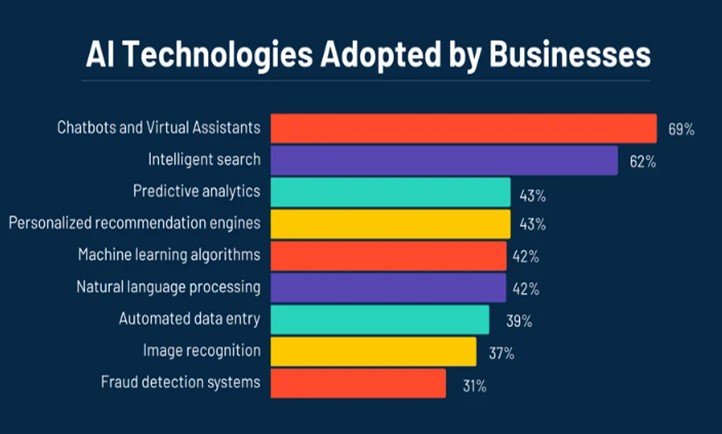
The adoption of AI in businesses ranges from chatbots to business intelligence tools and robots. These AI technologies are employed in different business processes depending on business needs. A report from G2 reveals that AI chatbots and virtual assistants are the most widely adopted technologies, with adoption rates reaching up to 70%. 62% of organizations utilize intelligent search tools to extract insights from unstructured data. Meanwhile, 43% of companies have implemented predictive analytics and personalized recommendation engines to guide their data-driven decision-making. As of the time of the survey, 83% of organizations that adopted an AI solution in the last three reported a positive return on investment.
AI is ready and is becoming more than a tool. G2 reported that 75% of businesses have incorporated two to five AI features into their processes, while 17% have integrated six to eight AI capabilities across their operations. Businesses need to come to terms with the revolution AI offers and identify how and where AI will be impactful to their business. Businesses that delay the adoption of AI into their processes risk being outpaced.
Many businesses today understand the possibilities of AI but struggle to understand how AI fits their specific needs. The best way to understand how AI can fit into business processes is to see and understand how it’s already being used in the same business sector. Another way is to start with small, focused pilot projects. This will give the opportunity to test AI implementations and measure their business impacts with minimal risks.
It is worth noting that the adoption of AI paves the way to radical transformations in business processes, but it’s very important to weigh the benefits, address potential drawbacks, and proactively manage risks and ethical concerns.